|
Both of these examples occur at normal atmospheric pressure.But higher pressures can also change a vapour(or gas) into a liquid.For example,if you look at a typical cigarette lighter,you can see liquid inside it .But as soon as you push down on the button,butane gas comes out why ? The butane is under high pressure inside the cigarette lighter.This high pressure causes the butane to take liquid form.As soon as the butane is released and it encounters normal atmospheric pressure ,it turns back to gas.
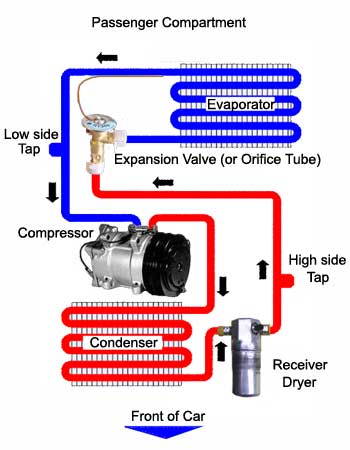
Ok those are the basic idears.But how do they apply to making your can vents blow cool air ? The principles of evaporation and condensation are utilized in your cars A/C system by a series of components that are connected by tubing and hoses.There are six basic components.. the compressor,condenser, receiver drier,thermostatic expansion valve,the evaporatorand the life blood of the A/C system ,the refrigerant.
Refrigerant is a liquid capable of vaporizing at a low temperature.In the past,R-12 refrigerant was used in cars.But this (cfc) is harmfull to the earths ozone layer.Consequently,all vehicles built after 1996 use R134A.a more environmentally friendly refrigerant.
Here`s how an air conditioning system and its components work.
STEP ONE,The compressor is the power unit of the A/C system. It is powered by a drive belt connected to the engine's crankshaft. When the A/C system is turned on, the compressor pumps out refrigerant vapour under high pressure and high heat to the condenser.
STEP TWO,The condenser is a device used to change the high-pressure refrigerant vapour to a liquid. It is mounted ahead of the engine's radiator, and it looks very similar to a radiator with its parallel tubing and tiny cooling fins. If you look through the grille of a car and see what you think is a radiator, it is most likely the condenser. As the car moves, air flowing through the condenser removes heat from the refrigerant, changing it to a liquid state.
STEP THREE,Refrigerant moves to the receiver-drier. This is the storage tank for the liquid refrigerant. It also removes moisture from the refrigerant. Moisture in the system can freeze and then act similarly to cholesterol in the human blood stream, causing blockage.
STEP FOUR,As the compressor continues to pressurize the system, liquid refrigerant under high pressure is circulated from the receiver-drier to the thermostatic expansion valve. The valve removes pressure from the liquid refrigerant so that it can expand and become refrigerant vapour in the evaporator.
STEP FIVE,The evaporator is very similar to the condenser. It consists of tubes and fins and is usually mounted inside the passenger compartment. As the cold low-pressure refrigerant is released into the evaporator, it vaporizes and absorbs heat from the air in the passenger compartment. As the heat is absorbed, cool air will be available for the occupants of the vehicle.A blower fan inside the passenger compartment helps to distribute the cooler air.
STEP SIX,The heat-laden, low-pressure refrigerant vapour is then drawn into the compressor tostart another refrigeration cycle.
The best thing about air conditioning is that all you have to do is press a button to make it work air conditioning systems are pretty reliable. On a modern and relatively new vehicle, it is rare to have problems. And if there are problems, they are pretty much one of two things: No cool air or insufficient cool air. If you own an older car and its A/C system doesn't seem to be working properly,here are some general troubleshooting tips:
.Loose or broken drive belt.
Defective expansion valve
Clogged expansion valve, receiver-drier or liquid refrigerant line
Blown fuse
Leaking component: any of the parts listed above or one of the A/C lines, hoses or seals
noperative compressor or slipping compressor clutch
Inoperative compressor or slipping compressor clutch
Low refrigerant charge
Loose drive belt
Slipping compressor clutch
Clogged condenser
Clogged evaporator
Slow leak in system
Partially clogged filter or expansion valve
Most A/C repairs are best left to a specialist. Recharging the refrigerant, in particular, requires special equipment that most people don't own. There are a couple things you can do, however. First, make sure to have the system checked regularly according to your vehicle's owner's manual. Second, during the winter months, it might not make much sense to run the A/C, but many manufacturers recommend running your A/C system regularly, because it contains a light mineral oil in the refrigerant to keep the compressor properly lubricated. The general rule of thumb is 10 minutes per month. Some heating, ventilation and air conditioning systems also engage the A/Ccompressor for defrost mode.
Aircon advice.
Your air-conditioning system can be blended with your heater to provide you with clean, purified and dehumidified air. It should be used all year round, do not leave it turned off for long periods of time as the system will suffer from a lack of lubrication. If you do not use your air-conditioning for whatever reason turn it on at least once each week for half an hour.
|